With recent news headlines (https://abcnews.go.com/US/happen-colorado-river-system-recover-historic-drought/story?id=98475953) warning of the extreme drought conditions hitting the western U.S. and the region that makes up the Colorado River basin, cutting water use has become top of mind for many citizens and leaders in Colorado and beyond. One city in Colorado has approved a plan to cut water use in the face of this historic drought, and this plan is raising some eyebrows and generating its own headlines due to its potential impacts.
In the summer of 2022, the city council for Aurora (Colorado’s third largest city), approved restrictions on high water turf lawns for all new construction. Originally proposed by Aurora mayor Mike Coffman, all ten members of the city council voted to approve the new ordinance which limits the amount of turf lawns in new developments and golf courses. (https://www.denverpost.com/2022/08/23/aurora-limits-grass-lawns-golf-courses-water-usage/)
The ordinance prohibits water guzzling turf lawns in common areas, medians, curbside landscape and front yards. In back yards, lawns must be equal to or smaller than 45% of the area, or 500 square feet, whichever is smaller. However, an exception was included to allow front yard turf lawns for residences whose backyards are too small to fit the 45% or 500 square feet threshold.
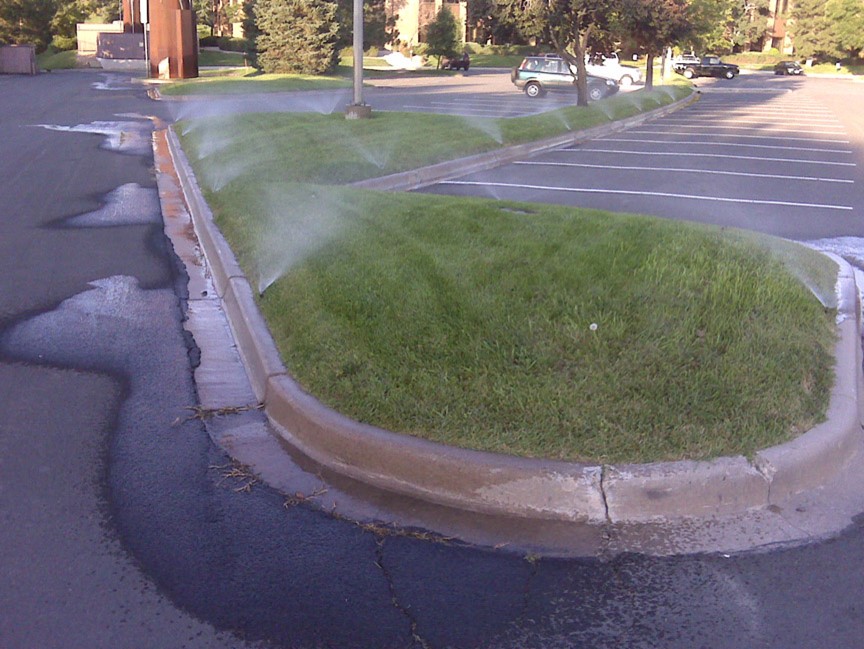
Perhaps most importantly, the ordinance restricts turf from being used merely for decorative purposes in common areas unless it is for use in “active or programmed recreation areas.” The skinny strips of lawn often found in older commercial developments which are inefficiently irrigated as water over-sprays wastefully on to nearby walks, streets and parking lots, will hopefully become a relic of the past.
Wasting water in a parking lot.
Considering that the typical high-water lawn needs 25″ of water annually to look good and green, and Aurora (as well as most of the front-range urban corridor of Colorado) only receives 15″ of natural precipitation all year, reducing or eliminating non-active or un-programmed turf lawns is a very easy way to reduce urban and suburban water use.
This is why another recent headline grabbing story regarding reducing turf lawns was welcome news. In June 2022, the State of Colorado passed a bipartisan-sponsored measure that will encourage property owners across the state to ditch their water-wasting turf lawns (https://leg.colorado.gov/bills/hb22-1151).
The legislation is intended to use state funds ($2 million) to financially incentivize the voluntary replacement of irrigated turf with water-wise landscaping. The bill, HB22-1151, requires the Colorado water conservation board to develop a statewide program that would distribute funds to various “local governments, certain districts, Native American tribes, and nonprofit organizations” for lawn replacement programs. Those funds could then be used to pay property owners to reduce their landscape irrigation by transitioning away from high water turf lawns, towards more climate appropriate landscape treatments. The funds could also go towards expanding some existing programs that already pay property owners to replace water-thirsty lawns, about $1 to $3 per square foot of removed sod. Most of these rebates are only offered in cities in Colorado and not unincorporated areas. One goal of this legislation is to broaden this type of program to other areas in the state.
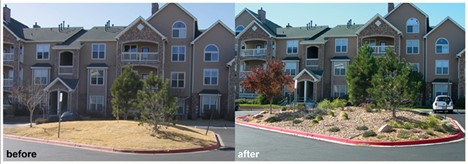
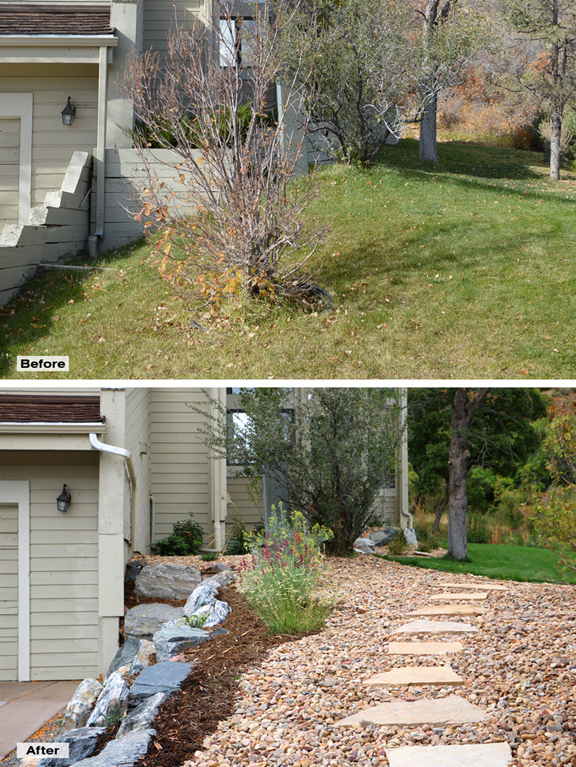
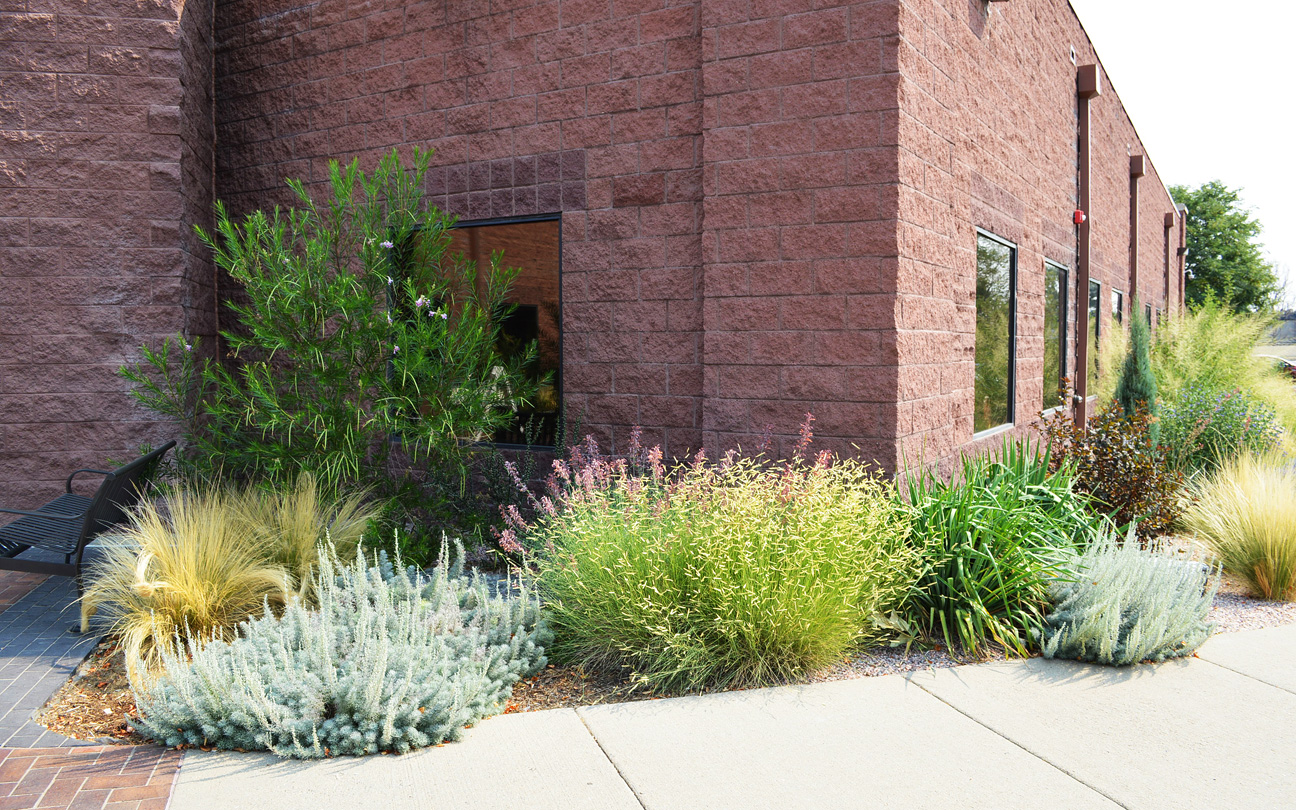
An example of a water saving landscape renovation at a multi-family property in Aurora, CO.
While $1 to $3 per square foot of removed sod may seem generous, there are reports of some landowners in California getting lawn replacement rebates up to $6/sf. (https://www.cnn.com/2022/08/19/us/california-drought-lawns/index.html). Interestingly, some of the rebate programs in California also require installation of rain barrels as well as turf lawn replacement. That is an intriguing idea for rebate offering entities in Colorado to consider, especially since rain barrels only became officially legal just a few years ago.
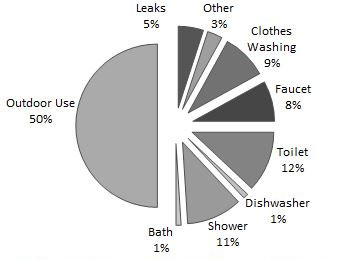
Researchers at Colorado State University estimate that landscapes account for at about 55% of the total annual water use for a typical single family home in Colorado.
Typical Colorado household water use; CSU extension
And most of this goes towards lawn irrigation. In the city of Denver for example, it’s estimated that nearly 25% of the city-wide entire annual water consumption is sprayed on high-water turf lawns. (https://denverite.com/2019/05/06/denverites-can-use-120-million-gallons-a-day-to-water-their-lawns/) Considering that lawns are only irrigated about half of the year or less in Colorado, that is a lot of water that could easily be saved if more lawns were changed into climate appropriate landscape treatments.
Let’s hope that the recent passage of Aurora’s lawn restriction as well as HB22-1151 helps usher in a more water conserving and water conscious future in Colorado and other states in our drought prone region. This won’t translate into a complete disappearance of high-water turf lawns. However, for the sake of our rivers, aquifers and reservoirs, it means that these water-hogging green carpets must be used wisely and judiciously in the designed landscapes of the future.
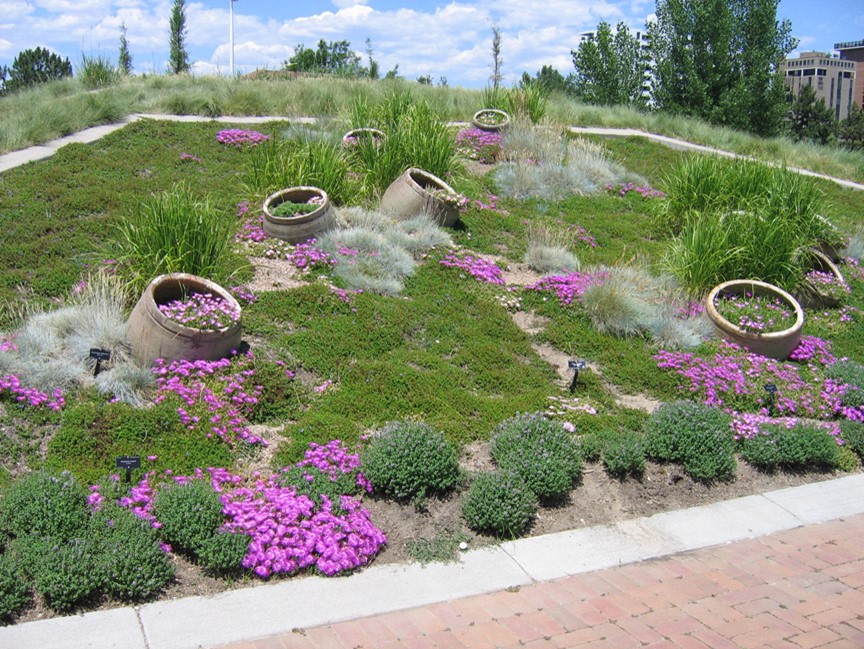
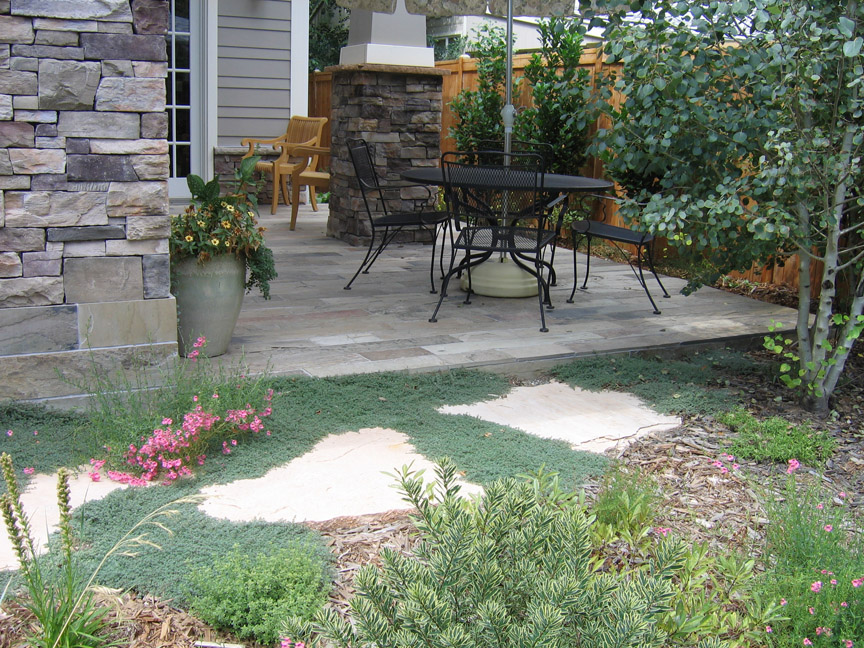
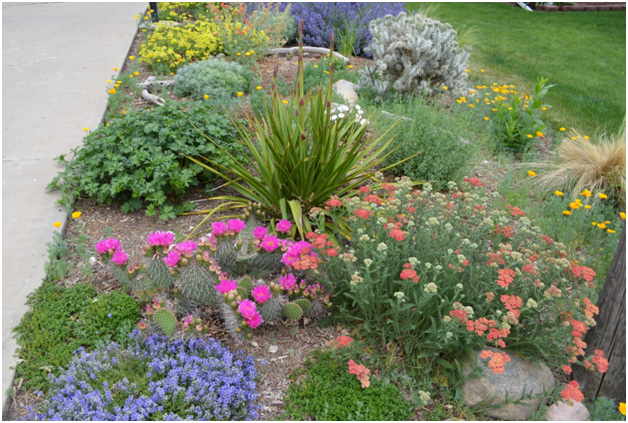
Example of beautiful low-water groundcover alternatives to high water turf lawn.
This is the official blog of Outdoor Design Group, Colorado Landscape Architects. For more information about our business and our services, click here.
Once upon a time, there was a castle guarded by soldiers. Enemies obscured by the trees would sneak close to the castle, so the soldiers reduced the threat by removing the trees. Without the trees, the land filled in with grasses, thyme, and chamomile. Animals began to graze in these new fields, keeping the plants low. The soldiers could see clearly across the land, and the sheep were fat and happy. The castle prospered, and everyone who visited wished their land could be so grand. The other land owners cut down their trees and filled in their land with grasses. The smell from the grazing animals wasn’t ideal, so they brought in men to cut the grasses low instead.
The “green carpet” surrounding the finest castles and estates in the 16th & 17th century became a status symbol, and planted the seed for the sod lawn we’re all familiar with today.
In the United States after WWII, automobile technology and availability took off. With the open road ahead of them, well-to-do folks left the cramped urban conditions of the cities, moving outward to new suburban neighborhoods.
Planners like Frederick Law Olmsted and Abraham Levitt gave the people sprawling neighborhoods, with acres of lush green grass. With the popularity of the 2-day weekend on the rise, homeowners indulged in their green Edens. This ignited a new chapter for the centuries old status symbol of the turf lawn – now repurposed for mini-golf and lawn bowl rather than spying enemy invaders and feeding livestock.
“No single feature of a suburban residential community contributes as much to the charm and beauty of the individual home and the locality as well-kept lawns” – Abraham Levitt
Ingrained into the new vision for the American Dream, well-kept lawns became the golden standard. With an estimated 30 to 40-million acres of the United States serving as an irrigated sod lawn today, this status symbol is butting heads with our resources and priorities.
The cold hard truth about lawns are that they are a water hog, high maintenance (what other non-food-production plants do you cut weekly, fertilize seasonally, and treat with chemicals?!), lawns are a food desert for animals & insects, and they do nothing for our groundwater while the water runoff often pollutes creeks and streams with high nitrogen fertilizers, causing harmful algae blooms. All of that lawn maintenance also creates air pollution and noise pollution from mowers, blowers, and trimmer equipment.
A renovation project where Outdoor Design Group helped our client reduce their turf lawn.
But lawns can be great in the right location!
This is where “active-use” vs. “passive-use” spaces come into play. Lawns can be very durable, and are amazing for active children and pets. Maintaining a lawn to play and entertain on is a lovely idea. Kentucky Bluegrass has been a popular turf choice for decades, but climate suited alternatives like Dog-Tuff Buffalo Grass, Bermuda grass, or “steppable perennial lawns” made up of creeping thyme or clover can serve the same purpose as high-water turf lawns with fewer drawbacks. While choosing the right type of lawn for your environment is a start, reducing the overall amount of lawn is still the key to a progressive and sustainable landscape. Maintaining any type of lawn on the side or front of your house where no-one ever spends their time is wasteful for you, your wallet, and the environment.
Steppable groundcover used with other perennials, step stones and mulch.
Consider ditching the golf-course-quality front-yard peacocking and save that neighborly competitiveness for the holiday light display. Instead, beef up your shrub beds, add some neat planters, and opt for native seed mixes that include drought-tolerant grasses & wildflowers. Keep your lawn only where you will use it, and plant a nice tree just west or south of it to keep it cooler and healthier during hot sunny days.
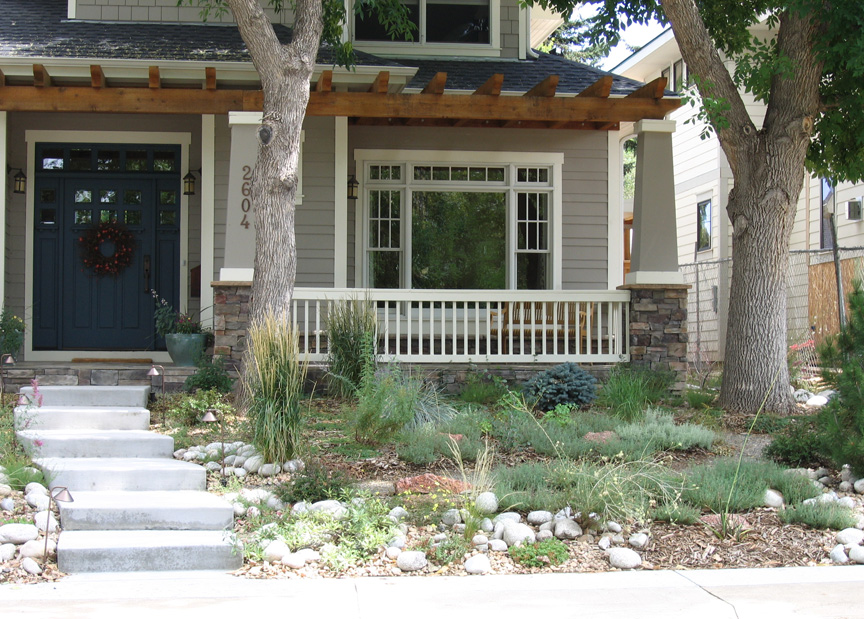
A front yard filled with a diversity of ornamental grasses, perennials, shrubs, landscape rock and mulch.
This is the official blog of Outdoor Design Group, Colorado Landscape Architects. For more information about our business and our services, click here.
In 2016, the congregation of Saint Francis of Assisi
Catholic Church in Longmont, Colorado decided to expand their existing building
to better serve their growing congregation. The proposed addition to the
existing building would impact the existing landscaping, so our company was
hired to design the renovation and adjustments of the landscape around the
building.
The remodel of the building will be done in multiple phases.
So far, phase 1 of the renovations has been constructed.
The rendered landscape plan for the Saint Francis of Assisi Church.
Like many church construction projects, this one had to be
cost conscious. Due to budget constraints and various budget reviews, the
proposed plantings were adjusted several times during the planning stages to
best fit the current needs of the budget.
One particular technical challenge was the assessment and modification
of the existing irrigation system and pumps. Our irrigation specialist was
dispatched to the field multiple times to work with the Church’s maintenance
crew to puzzle out the best way to adjust and modify the existing irrigation
system. In the end, we were able to bridge the new and existing irrigation
systems into a cohesive whole.
From a planting design perspective, the client had a few key
points they wished to address: Blend new and existing plants seamlessly; create a low maintenance & low water use
landscape; and add seasonal focal points to pair with the liturgically
appropriate seasonal milestones that are critical to the Church.
Our team worked with the Church’s maintenance team to ensure
the plantings and other landscape elements would be low maintenance. Hearty and
reliable plant species were chosen for the design. We also wanted the new
plantings to blend seamlessly with the existing landscaping. In addition to
these criteria for the plants, we also ensured the plantings in the expanded
parking lot would not obscure any critical sight lines for pedestrian and
vehicle safety.
To create seasonal focal points, we considered different
plants that might be at their peak during significant seasonal holidays. One
good example of this is forsythia shrubs with their glorious yellow blooms that
appear close to Easter, a very significant holiday in the Catholic Church. Not
only are the seasonal focal points a visible manifestation of seasonally
significant biblical events, these planting nodes provide attractive backdrops
for photo opportunities during church sponsored events such as weddings.
Working on the landscape renovations for the Saint Francis
of Assisi Catholic Church was a wonderful experience for our design team. It was satisfying to help the Church achieve
their landscape design goals for their congregation and stay on budget.
This is the official blog of Outdoor Design Group, Colorado Landscape Architects. For more information about our business and our services, click here.
Some of our favorite projects here at Outdoor Design Group are the landscape renovations. These kind of projects can be quite challenging to work on, but they often turn out to be the most rewarding once the project is completed, the site takes on a fresh new look and the plants have begun to fill in and show off.
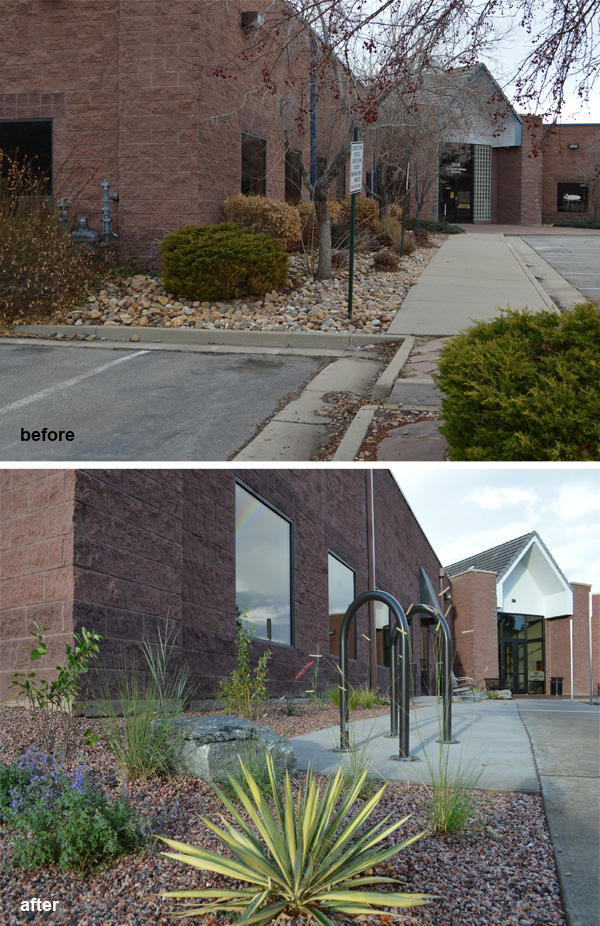
A recent project for a non-profit organization near our office was completed a couple years ago, and the landscape plants have been looking great ever since. The landscape areas around the entrance to this organization’s building face mostly south and west with ample amounts of sunshine. With this in mind, we knew we could design a xeric planting plan that would look great throughout a long hot summer, replacing the old plants on site that were more water needy.
And because of the south facing entrance, we had the opportunity to utilize plants that are typically a little too frost tender for the Denver area. But that southern entrance to this building gave us warmer micro-climates we could play with to plant more unique varieties of plants for our area, such as Desert Willow and a selection of cacti.
Luckily our client on this project was a wonderful partner in the endeavor and was very open to the idea of a new landscape of low water and native plants for their freshly renovated office building. The before and after photos shown below offer a glimpse of the transformation:
Painted Lady Butterflies enjoying the xeriscape plants at this Olde Town Arvada landscape makeover.
This is the official blog of Outdoor Design Group, Colorado Landscape Architects. For more information about our business and our services, click here.
As water prices rise, and the climate warms, water conservation is becoming even more important. Colorado’s current population is estimated to be 5,695,564, nearly 700,000 higher than in 2010. That 13.2 percent growth is the fourth highest among all states over that time period.
All these new residents continue to put a strain on water supplies. It makes perfect sense then, to encourage Xeriscape, which, as we’ve written in the past (the-7-principles-of-xeriscape-revisited-30-years-later), is a form of landscape design that requires much less water.
We are pleased to hear of HB19-1050, a new bill in the Colorado General Assembly, that encourages the use of Xeriscape in common landscape areas.
Section 1 of the bill augments an existing law that establishes the right of unit owners in common interest communities to use water-efficient landscaping, subject to reasonable aesthetic standards, by specifically extending the same policy to limited common elements, which are owned by the community and available for use by some but not all of the unit owners.
Sections 2 and 3 extend existing water conservation requirements, currently applicable only to certain public entities that supply water at retail and their customers, to property management districts and other special districts that manage areas of parkland and open space.
This is the official blog of Outdoor
Design Group, Colorado Landscape Architects. For more information about
our business and our services, click here.